
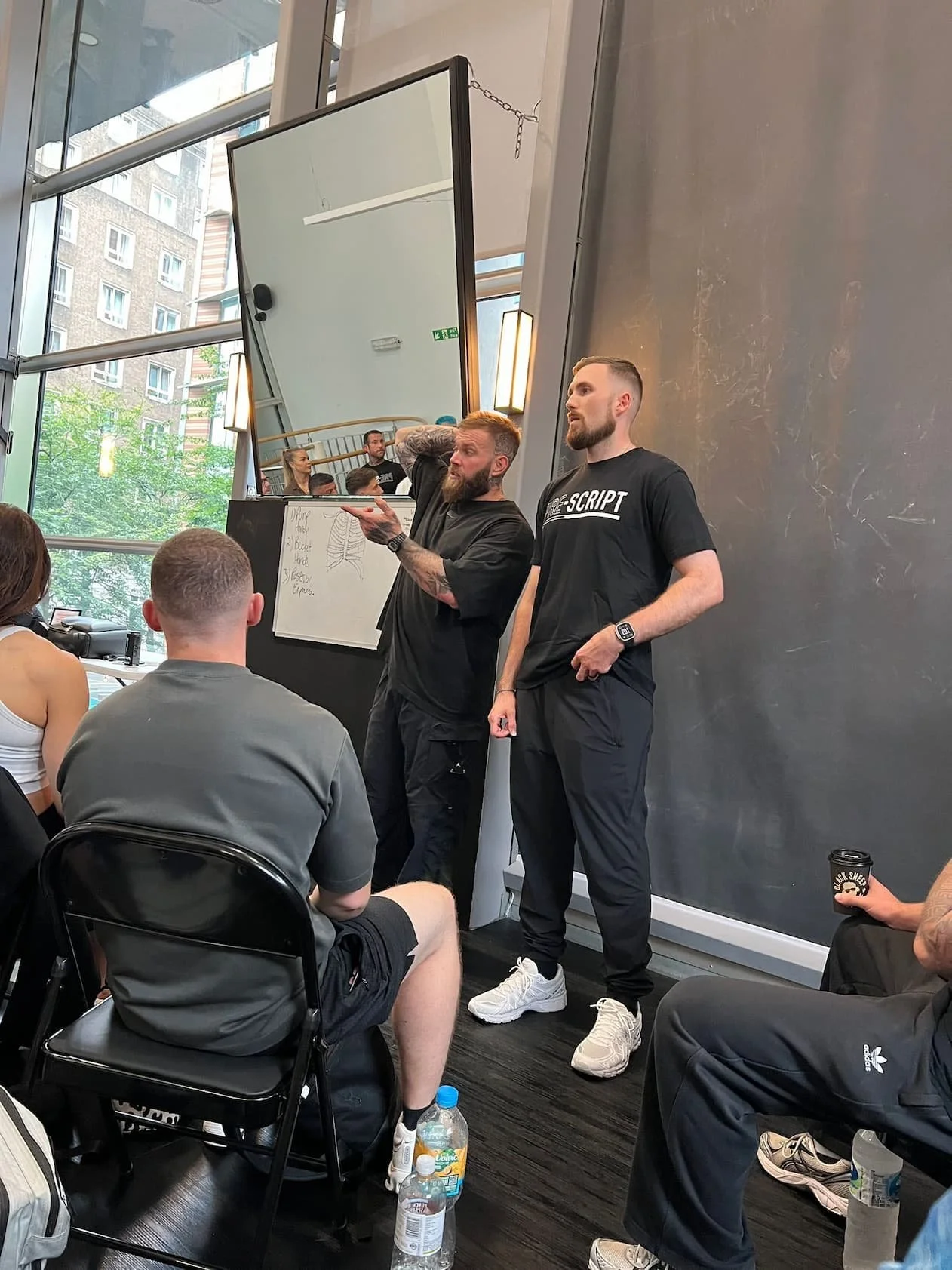
I had the opportunity to hop across the pond this weekend and join Jordan for a Pre-Script intensive in London. I had a few thoughts on paper going into the weekend for what I'd send out this week, but I also knew there'd be more than a handful of ideas and concepts I'd flag over the weekend to share here across the next few weeks.
Funny enough, one of the topics that came up was one I'd already written half a post on.
I spent the first part of my coaching career working in a physical therapy clinic, where adages like "motion is lotion" and "movement is medicine" are quite literally painted on the walls. One of the classics that goes with them: "proximal stability for distal mobility," or "proximal rigidity for distal mobility."
Stability is a bit of a buzzword if we don't define it, so let's define it cleanly: our ability to resist force. Where this really falls short is viewing stability as an isolated entity, when stability in an applied sense is a very dynamic process.
In sport, we see this all the time. Think of OBJ jumping up to catch his famous catch: tons of spinal extension, shoulder flexion, then snatching the ball back down and landing in a closed position.
Baseball pitchers whip their body down the mound with insane degrees of extension that finish on the exact opposite end, extreme global flexion. Do they rely on a rigid, stable base, or is stability a much more complex process?
Typically when we hear the word stability, we imagine common core stability exercises like a plank, or something a little more dynamic yet still remedial, like a bird dog or a dead bug. Gotta have that stable core, right?
While there are scenarios where we do want to create proximal stability of the rib cage and pelvis as we move more distal inputs like the shoulder and hip, there are far more scenarios where we want reciprocal motion through the rib cage and pelvis that facilitates better movement.
In a general sense, we want the ability to create both proximal and distal stability and mobility, and really the variability to integrate that properly in movement.
Higher skill motor tasks require a high degree of coordination that needs both proximal and distal input, especially when it comes to touching end ranges of joint motion.
In the same way a pitcher needs to access meaningful degrees of spinal extension, scapular retraction, and shoulder external rotation as they pitch, we should also have the coordination to create proximal stability to create relative motion between the rib cage and shoulder in an exercise like a landmine press.
In the same way an elite sprinter may organize themselves with some backside mechanics, we also want the ability to stack the rib cage over the pelvis as we move through a front foot elevated split squat.
In both examples, we're not only reliant on strict rigidity of the rib cage and pelvis. The goal is to express movement variability and create meaningful degrees of stability, both proximally and distally, through different phases of movement. We haven't even mentioned the importance of maintaining good foot and hand pressures, as well as the direct influence of head position.
The body doesn't primarily operate by establishing a rigid base and then allowing distal movement. It operates by continuously coordinating stability and mobility across the entire system, maintaining an appropriate relationship between its segments despite ongoing movement and perturbation.
You may be asking me what the fuck am I getting at here by this point. The takeaway I want from this is that we shouldn't look at movement in a vacuum.
If we are reducing down a weak link in a highly complex motor pattern, or a nagging injury in an elite athlete, to our lack of dead bugs or Pallof presses in a program, we are probably missing the point.
Understand when a lack of proximal or distal stability is hindering our ability to create the relative motion between joint segments we need to express variability in a given muscle or muscle group. And understand when more globally oriented movement is actually necessary, not a flaw, just a byproduct of the motor task at hand.
Want help applying this with your own clients? Book a free coach advisory call.
Get the next article a week early. Subscribe to the Unbranded Performance newsletter.